
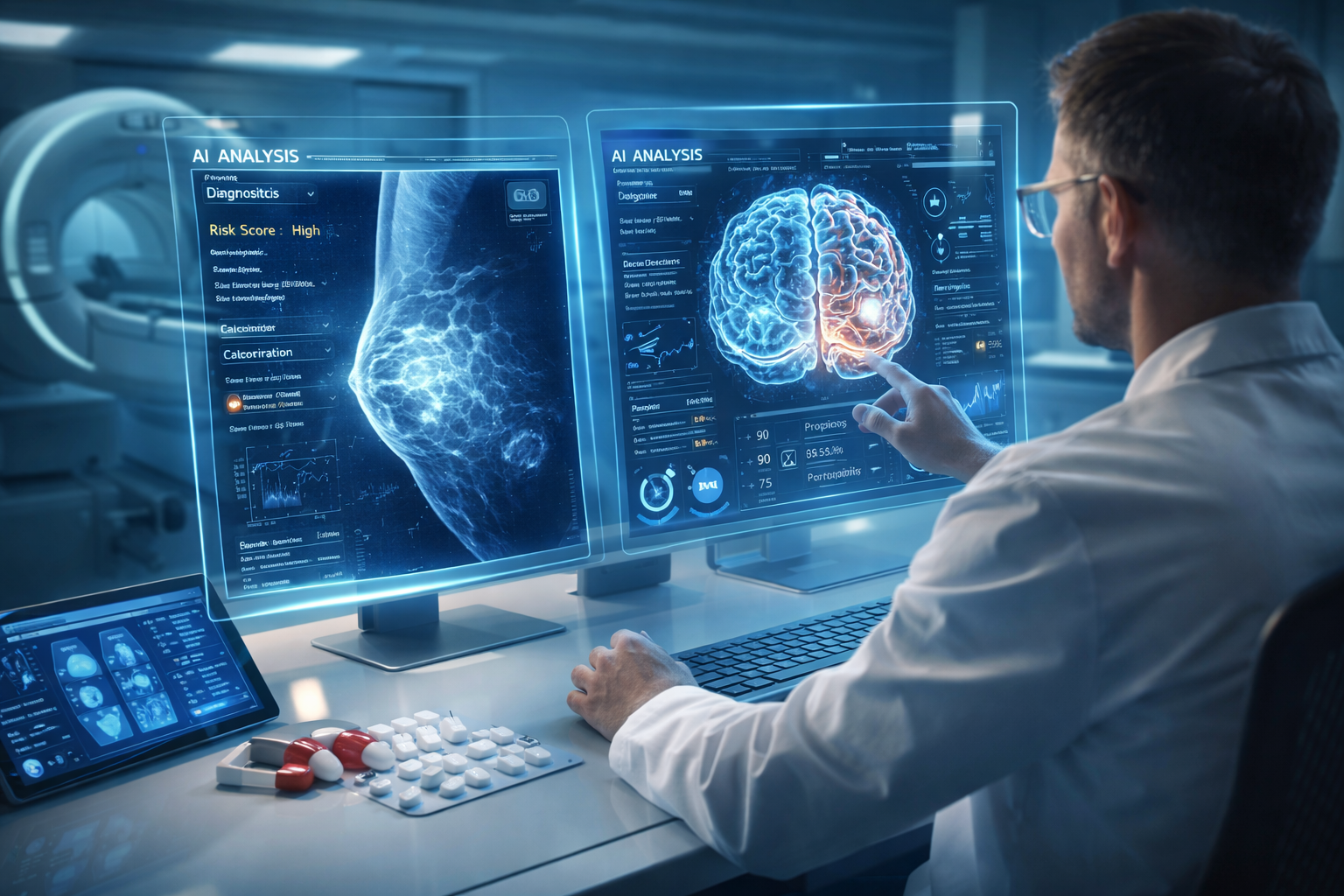
Artificial intelligence is revolutionizing healthcare diagnostics in 2026, with AI systems detecting breast cancer and stroke warning signs before symptoms emerge, increasing surveillance capabilities by 200% in some locations. These advanced diagnostic tools can analyze thousands of medical images, lab results, and clinical notes in seconds, enabling clinicians to detect early signs of cancer, cardiovascular disease, and neurological conditions long before traditional methods would identify them.accesshealthcarestaffing+1
AI in Breast Cancer Detection
Enhanced Accuracy and Early Detection
AI algorithms have achieved remarkable success in breast cancer screening, reaching 90% sensitivity in detection compared to 78% for human radiologists. By "learning" to recognize patterns through vast datasets, AI technology can spot even the smallest signs of breast cancer, sometimes catching what the human eye might miss. For patients with BRCA gene mutations, AI has demonstrated the ability to detect signs of cancer up to a year before traditional imaging methods.scispot+1
These sophisticated algorithms scan mammogram images for abnormalities and flag anything suspicious, working continuously and consistently to make early detection easier for doctors. AI can identify tiny details such as microcalcifications—small calcium deposits that serve as early warning signs of cancer—with impressive accuracy, often spotting issues faster and with fewer mistakes than traditional methods.shebaonline+1
Reducing Unnecessary Procedures
AI-powered diagnostic platforms have significantly decreased unnecessary biopsies by 30% while maintaining high detection accuracy. By accurately identifying which findings are benign versus malignant, AI helps prevent overdiagnosis and spares patients from extra stress, discomfort, and costs associated with unnecessary procedures. This precision not only improves patient outcomes but also optimizes healthcare resources.shebaonline
At Sheba Medical Center, AI-powered diagnostic systems have reduced cancer diagnosis time from weeks to minutes. Tools like MICA's DENISE AI accurately interpret mammograms with remarkable speed, while Imagene's AI platform quickly identifies essential cancer biomarkers, allowing treatment to begin sooner.shebaonline
Improved Image Quality and Analysis
AI enhances diagnostic imaging through multiple capabilities. The technology sharpens images by removing "noise" that could obscure tiny details, giving radiologists clearer pictures and greater confidence in their assessments. AI can compare past and current images to detect subtle changes in tissue that may indicate early signs of cancer, providing longitudinal analysis that human reviewers might miss. The speed of AI analysis means results return much quicker, helping patients receive answers and start treatment sooner if needed.shebaonline
AI in Stroke Prediction and Detection
Predictive Analytics for Early Warning
AI-powered stroke prediction models have demonstrated exceptional performance in identifying at-risk individuals before symptoms appear. Long Short-Term Memory (LSTM) deep learning models have achieved 96.15% sensitivity in stroke prediction, showcasing their proficiency in identifying individuals at risk and enabling effective preventive healthcare measures. Applied to raw EEG data, LSTM models reached 94.0% accuracy in predicting stroke with remarkably low false positive rates (6.0%) and false negative rates (5.7%).nature
This high sensitivity indicates the potential for early intervention strategies aimed at reducing stroke incidence and associated morbidity and mortality rates. Studies have shown that both Random Forest machine learning algorithms and LSTM deep learning approaches effectively detect and predict strokes using real-time EMG bio-signals.nature
Real-Time Detection and Treatment
AI platforms like Viz.ai have revolutionized acute stroke care by synchronizing treatment and reducing systemic delays between patients and life-saving interventions. The software engages in preliminary diagnoses and stroke patient triage, with AI capable of detecting suspected large vessel occlusion (LVO)—a common predictor or symptom of ischemic stroke. This rapid detection enables healthcare teams to mobilize immediately, significantly improving patient outcomes in time-critical situations.referralmd
The effectiveness of LSTM models in predicting stroke and hemorrhagic transformation highlights their significant potential for improving management and therapy customization in acute ischemic stroke patients. These results advocate for integrating advanced deep learning models into routine clinical practice to optimize patient outcomes and reduce the burden of stroke-related morbidity and mortality.nature
Broader AI Diagnostic Capabilities
Comprehensive Medical Analysis
By 2026, AI-powered diagnostic systems have become essential components of modern healthcare, capable of processing vast amounts of medical data with unprecedented accuracy and efficiency. These systems integrate and analyze diverse data types, including electronic health records, imaging data, genetic information, and social determinants of health, providing a comprehensive view of patient health. This holistic approach enables more personalized and precise diagnoses, ultimately leading to better treatment outcomes.scispot
In radiology, AI algorithms analyze images within seconds, providing immediate insights crucial in emergencies and critical care scenarios where every minute counts. Laboratory settings benefit from AI-based diagnostics that process and interpret test results rapidly, reducing turnaround times and improving patient care.scispot
Predictive Analytics and Clinical Decision Support
AI excels in predictive analytics, helping healthcare providers anticipate disease progression and patient outcomes before complications occur. By analyzing patterns in patient data, AI identifies risk factors and predicts potential complications, enabling proactive interventions. Johns Hopkins Hospital and Microsoft Azure AI collaborated on implementing AI-driven predictive analytics, leveraging electronic health records, medical imaging, and genomic information to predict patient outcomes such as disease progression, readmission risks, and response to treatments.scispot
Machine learning algorithms enable Clinical Decision Support Systems to analyze patient data and make predictions supporting diagnosis and treatment planning. Natural Language Processing helps AI extract valuable information from unstructured clinical notes, creating detailed understanding of patient conditions.scispot
The Future of AI Diagnostics
The year 2026 represents a pivotal moment for healthcare, driven by rapid adoption of generative AI, evolving governance frameworks, and renewed focus on workforce empowerment. AI healthcare innovations including computer vision, natural language processing, and advanced predictive analytics continue shaping the diagnostic landscape. According to Forbes analysis, AI-powered diagnostics, predictive analytics, and automation are accelerating early disease detection and clinical decision-making across healthcare systems.wolterskluwer+2
While challenges remain in areas such as data privacy, algorithm bias, and regulatory approval, the healthcare industry is developing robust frameworks to address these concerns and maximize AI's potential in diagnostics. The transformation from reactive to proactive healthcare, enabled by AI-powered predictive analytics and early interventions, promises more personalized care and significantly improved patient outcomes.scispot
-(2).png)
Comments 0
No comments yet
Be the first to share your thoughts!
Leave a Comment