
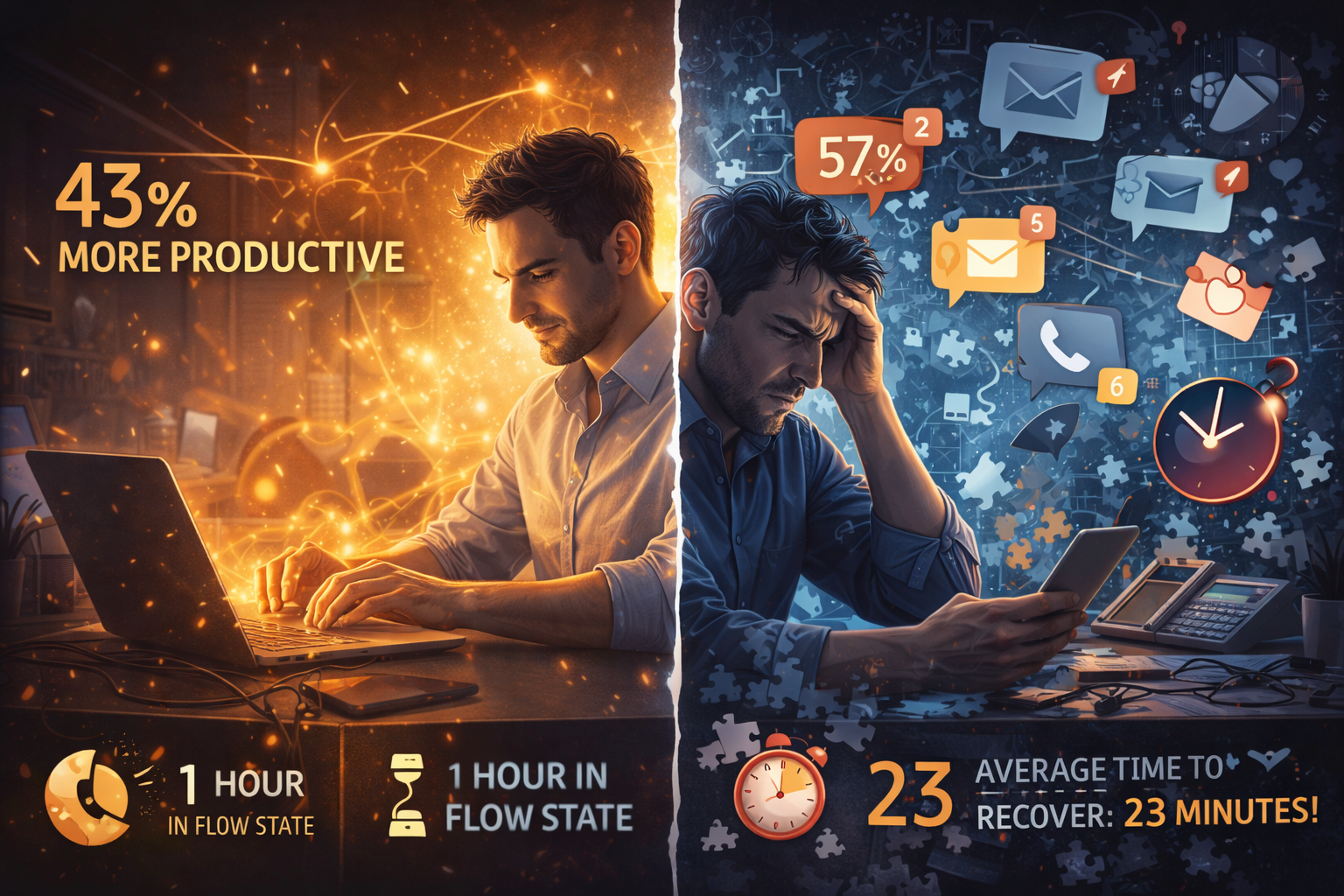
You check a quick notification. Five seconds, tops. Back to work, no harm done—right?
Wrong.
That "harmless" five-second distraction just cost you 23 minutes and 15 seconds of productive time.addyo.substack+2
This isn't speculation—it's the finding from groundbreaking research by Dr. Gloria Mark at the University of California, Irvine, who tracked knowledge workers throughout their workdays and timed every activity, interruption, and task switch.ideatovalue+1
The result? A productivity crisis costing the American economy $650 billion annually. And it's getting worse as our workplaces become more digitally connected, not less.[nonprofithr]
Welcome to the 23-minute reset phenomenon—the hidden tax on every distraction, interruption, and context switch that's quietly destroying workplace productivity and driving workers to burnout.
The 23-Minute Rule: What the Research Actually Shows
The Landmark UCI Study
In 2008, researchers at UC Irvine conducted a comprehensive study observing knowledge workers in their natural work environments. They followed employees and meticulously timed all their activities—especially every time workers changed what they were working on.[ideatovalue]
The shocking findings:tctecinnovation+2
Workers interrupted themselves by switching activities or applications every 3 minutes and 5 seconds
82% of interrupted work was resumed on the same day
It took an average of 23 minutes and 15 seconds for workers to fully refocus on their original task
Each interruption contributed to significantly higher feelings of time pressure and stress
Dr. Gloria Mark, the study's lead researcher, summarized it this way:
"We found about 82 percent of all interrupted work is resumed on the same day. But here's the bad news—it takes an average of 23 minutes and 15 seconds to get back to the task".[addyo.substack]
What "Refocusing" Actually Means
The 23-minute figure doesn't just measure how long it takes to physically return to a task. It measures the time needed to fully regain deep focus and cognitive flow after being interrupted.[tctecinnovation]
This includes:
The actual time spent on the distraction
The "resumption lag"—the mental reboot required to gather your wits and resources
Reorienting to where you left off
Rebuilding your mental model of the task
Recapturing the deep concentration state you had before
Think of it like a computer program: interrupting your focus doesn't just pause the program—it forces a complete restart, requiring all systems to reload from scratch.[addyo.substack]
The Math of Lost Productivity
The Daily Toll
Consider this scenario:
You're interrupted or distracted 6 times per day—a conservative estimate for most office workers.[clockify]
The math:
6 distractions × 23 minutes = 138 minutes (2.3 hours) lost daily
Across a 5-day week = 11.5 hours lost per week
Over a year = nearly 600 hours of lost productive time
But the reality is far worse. Research shows workers are interrupted approximately once every 10.5 minutes.nonprofithr+1
For an 8-hour workday:
That's roughly 45+ interruptions per day
Even if only half require the full 23-minute reset, that's still 8+ hours consumed by refocusing
Actual productive work? Maybe 1-2 hours[tctecinnovation]
This explains why a RescueTime report found that most knowledge workers average only 1 hour of true focus per day due to digital distractions.[tctecinnovation]
The Economic Impact
Individual level:
Every wasted hour in a day means $10,375 of lost productivity per worker each year, based on an average salary of $30 per hour.[womenofgrace]
Company level:
For businesses with 1,000 employees, these interruptions cost more than $10 million annually.[womenofgrace]
National level:
The total impact on the American economy: nearly $650 billion dollars per year.nonprofithr+1
Why Distractions Are So Destructive
The Context-Switching Cost
Every time you switch tasks, you're forcing your brain to:
Disengage from the current task
Move attention to the new task
Load the new context and rules
Re-engage cognitive resources
When returning: reverse the entire process
This context switching creates massive cognitive overhead.ideatovalue+1
The problem compounds: Workers don't just switch once. The UCI study found workers switched activities every 3 minutes on average. That means they're in a near-constant state of partial attention and cognitive overload.[ideatovalue]
The Myth of Multitasking
Despite what many believe, the human brain cannot truly multitask. What we call "multitasking" is actually rapid task-switching—and it's incredibly inefficient.[ideatovalue]
Each switch:
Drains cognitive resources
Increases error rates
Reduces work quality
Amplifies stress and mental fatigue
The Stress Amplifier
The 23-minute reset isn't just about lost time—it's about cumulative stress.addyo.substack+1
What the research found:
As interruptions pile up, workers have less time to complete their original tasks
This creates higher feelings of time pressure
Workers experience significantly more stress throughout the day
The stress doesn't end when work ends—it affects recovery time[pmc.ncbi.nlm.nih]
The Digital Distraction Epidemic
The Primary Culprits
According to recent workplace research:womenofgrace+1
Nearly 60% of work interruptions now involve:
Email
Social networks
Text messaging
Instant messaging (Slack, Teams, etc.)
Switching windows among disparate tools and applications
The frequency is alarming:
45% of employees work only 15 minutes or less without getting interrupted
53% waste at least one hour per day due to distractions
Social Media: The $650 Billion Problem
Social media distraction alone is costing organizations billions.nonprofithr+1
The pattern:
You're deep in concentration on an important task
A notification pings
"I'll just check this real quick" (5 seconds becomes 5 minutes)
Now you need 23+ minutes to refocus
Repeat throughout the day
By the end of the day: That "quick 5-minute break" actually consumed 28 minutes (5 minutes + 23-minute reset).[reddit]
The Illusion of Efficiency
Ironically, many of the tools designed to make communication "faster and more efficient" are actually destroying productivity.[womenofgrace]
The paradox:
Tools promise instant connection
But create constant interruption
Result: We're more connected but less productive than ever
The Impact on Mental Recovery
The Work-Life Spillover Effect
The 23-minute problem doesn't just affect your workday—it affects your ability to recover after work.[pmc.ncbi.nlm.nih]
Research on post-work recovery shows:
When workers face frequent interruptions during the day, they struggle with:
Problem-solving pondering that extends into personal time
Difficulty psychologically detaching from work during off-hours
Reduced ability to "switch off" mentally
Prolonged stress activation that prevents proper recovery
The Effort-Recovery Model explains that mental detachment from work is crucial for recovery—but constant interruptions during the workday make this detachment significantly harder to achieve.[pmc.ncbi.nlm.nih]
The consequence: Delayed recovery has been associated with a range of negative health symptoms.[pmc.ncbi.nlm.nih]
The Burnout Pathway
The cycle:
Constant interruptions create time pressure and stress during work
Incomplete tasks carry over mentally into personal time
Workers struggle to detach and recover
Sleep quality declines
Return to work without proper recovery
Repeat until burnout
What Actually Works: Evidence-Based Solutions
1. Create Sacred Focus Time
The strategy:
Block minimum 2-hour chunks in your calendar for focused work[ideatovalue]
Treat these blocks as non-negotiable meetings
Remove the ability for others to book over them
Why it works: Two uninterrupted hours allows you to build and maintain deep focus without triggering the 23-minute reset.
2. Limit Digital Access Points
Practical steps:[ideatovalue]
Set yourself as "unavailable" or "away" in chat systems during focus time
Turn your phone to airplane mode
Close email and messaging applications
Use website blockers for social media
Turn off all notifications
The principle: If the distraction can't reach you, it can't trigger the 23-minute reset.
3. Batch Similar Tasks Together
Instead of switching between different types of work, group similar activities and complete them in one focused session.[ideatovalue]
Examples:
Process all emails in one 30-minute block
Make all phone calls consecutively
Complete all administrative tasks together
Dedicate separate blocks for creative vs. analytical work
Why it works: Staying within the same context eliminates costly cognitive switching.
4. Set Clear Task Goals Before Focus Sessions
Before entering focus time:[ideatovalue]
Get absolute clarity on what you want to accomplish
Identify exactly what you need to complete the task
Gather all necessary materials and resources
Set specific, measurable completion criteria
Why it works: Clear goals prevent mid-session interruptions to find information or clarify objectives.
5. Embrace Boredom and Mind Wandering
Get comfortable:
Being in your own head
Away from constant stimulation
Letting your mind wander occasionally
Why it works: Constant distraction creates an addiction to stimulation. Building tolerance for quiet focus reduces the urge to seek interruptions.[ideatovalue]
6. Use the Flexible Pomodoro Approach
Rather than rigid 25-minute work blocks, work until you're genuinely no longer able to focus.[reddit]
The method:
Start working on a focused task
Continue as long as you maintain genuine concentration (30 minutes to 2+ hours)
Only take a break when focus naturally wanes
Use a timer to track total focus time, not to interrupt it
Why it works: Preserves natural flow states instead of artificially breaking them every 25 minutes.
7. Protect Your Team's Focus Time
For managers and leaders:
Establish "no meeting" blocks for the entire team
Create norms around communication response times (not instant)
Encourage use of status indicators (Do Not Disturb, Focusing)
Model the behavior yourself
Why it works: Individual efforts fail if the organizational culture demands constant availability.
The Hidden Benefits of Deep Focus
Beyond Productivity
When you protect yourself from the 23-minute reset cycle, you gain more than just efficiency:
Improved work quality:
Fewer errors
More creative solutions
Better strategic thinking
Reduced stress:
Lower feelings of time pressure
Greater sense of control
Improved work-life balance
Enhanced recovery:
Better psychological detachment after work
Improved sleep quality
More complete mental restoration[pmc.ncbi.nlm.nih]
Greater job satisfaction:
Sense of accomplishment
Reduced frustration
Increased confidence
The 23-minute refocus problem isn't just about lost productivity—though at $650 billion annually, that alone should command attention.[nonprofithr]
It's about:
The quality of your work
Your stress levels throughout the day
Your ability to recover after work
Your long-term mental health and well-being
The research is unambiguous: Every interruption, every distraction, every "quick check" costs you 23 minutes of productive focus time.addyo.substack+2
But here's the empowering truth: You have more control than you think.
By implementing even a few of the evidence-based strategies—creating focus blocks, limiting digital access, batching tasks—you can dramatically reduce the frequency of interruptions and reclaim hours of productive time each day.[ideatovalue]
The choice is yours:
Continue losing 2-3 hours daily to the refocus tax
Or protect your attention like the valuable, finite resource it truly is
Your productivity, your stress levels, and your mental health depend on it.
The 23-minute reset starts now—will you interrupt it, or protect it?
-(2).png)
Comments 0
No comments yet
Be the first to share your thoughts!
Leave a Comment